
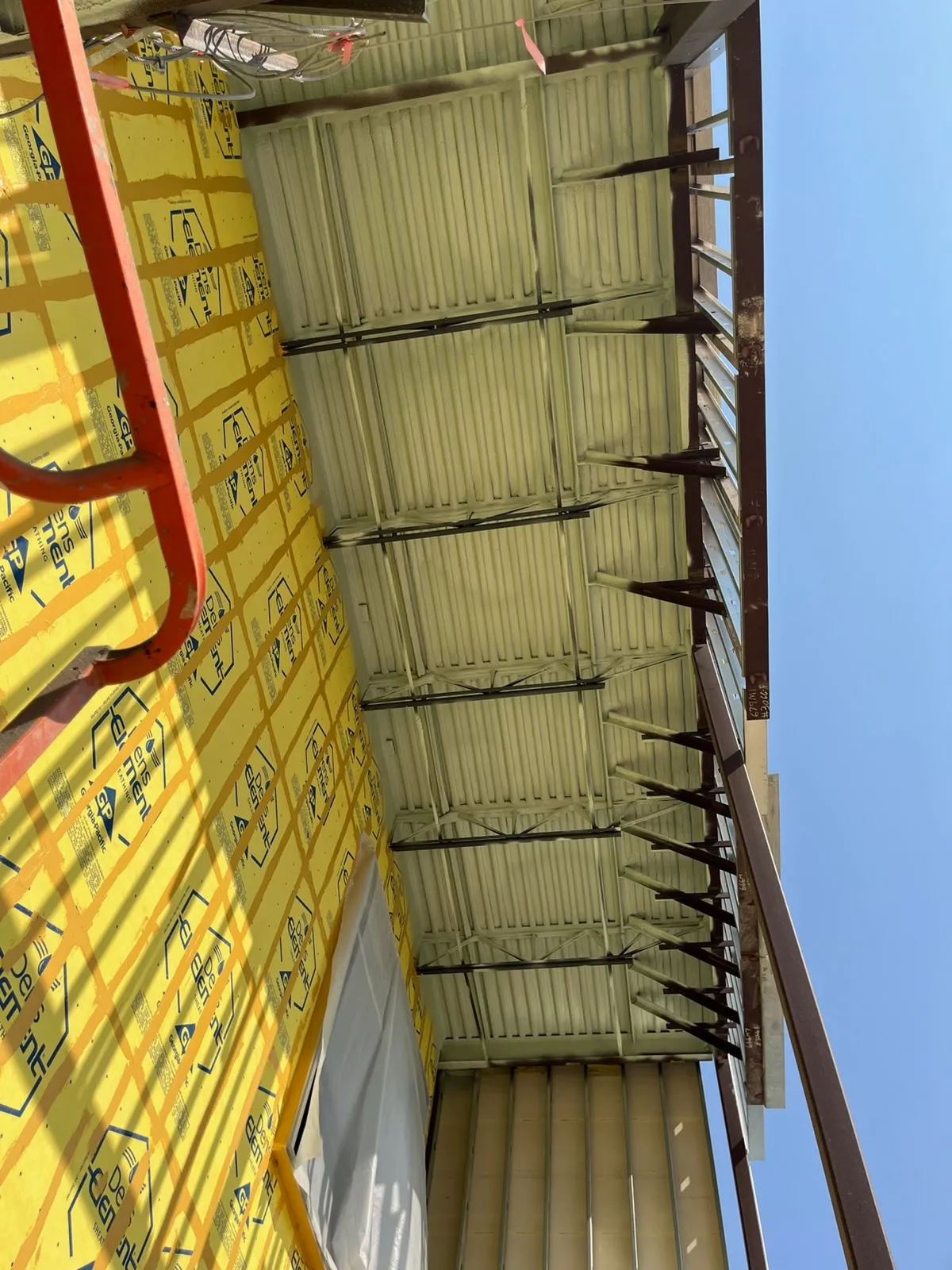
Roof deck foamed on a commercial building in northwest Houston. Panel laps and fasteners are covered in one continuous layer.
Where a flat roof actually leaks
Almost never in the middle of a panel or a membrane sheet. It leaks at laps, at fasteners, at curbs, at pipe boots, at the base of a parapet and around units. Every one of those is a joint, and every joint moves as the roof heats and cools. Houston gives a roof a 60 degree swing in a day and 60 inches of rain in a year, so those joints work themselves loose faster here than most places.
Sprayed polyurethane foam has no joints. It goes down as a liquid, expands, and self flashes around every penetration. Then the coating goes over the top as a monolithic membrane. The result is a roof surface with nothing to come apart, bonded to the deck rather than mechanically fastened, and adding meaningful R value while it is there.
The other advantage is drainage. Foam can be built up in thickness to fill low spots and move water toward drains, which is the fix for a roof that ponds after every storm. You cannot do that with a membrane without adding tapered insulation and a lot of money.
What we install
Roof foam
Closed cell roofing foam at 2.8 to 3 lb density, sprayed one to two inches for a recover and thicker where slope correction is needed. It is a different, denser product than wall foam and it is designed to be walked on and to take weather.
Silicone topcoat
Our usual recommendation on the Gulf Coast. Silicone handles ponding water and UV better than anything else in the category and does not chalk out in a few seasons. Bright white, so it reflects a big share of the sun that used to be heating your building.
Acrylic topcoat
Lower cost, good reflectivity, and a reasonable choice on a roof with real slope that never holds water. We will tell you which of the two your roof suits.
Granules and walk pads
Where people walk, we broadcast granules into the wet coat or add walk pads, so foot traffic to a rooftop unit does not wear the surface.
Coating only restoration
If the existing roof still has good insulation and just needs a watertight surface, we skip the foam and go straight to a coating system: clean, prime, detail every seam with reinforcing fabric, then two coats of silicone.
First we find out whether the deck is dry. If there is trapped water in the existing assembly, coating over it makes the problem permanent. That is what the core samples are for.
The evaluation before anything gets sprayed
If the roof is too far gone for a recover, we say so. A saturated deck or a structural problem is a re roof, not a coating job, and taking your money for foam over that would be dishonest work.
Roofs this suits
Metal buildings with through fastened panels, where the leaks are at the laps and the screws. Modified bitumen and built up roofs that are at the end of their surface life but structurally sound. Single ply that has gone brittle. Low slope additions on commercial buildings. Roofs with a lot of penetrations, where a membrane means a lot of hand flashing. Buildings where a tear off would mean shutting down the operation below, which is the reason a lot of Houston owners call us instead of a roofer.
Energy side of it
A white silicone roof reflects a large majority of the solar energy that hits it. Combine that with an inch or two of new foam and you have changed the top of the building from a heat collector into a barrier. On a single story warehouse in Houston, the roof is the dominant load, and this is the highest leverage surface on the whole building.
If your building has spray foam under the deck already, a coating on top extends the roof and protects the investment. If it has neither, doing both at once is the efficient path because we are on the roof once.
Maintenance and warranty
A coated roof is not a fire and forget system. Silicone systems come with manufacturer warranty options tied to mil thickness and inspection, typically ten to twenty years, and they hold up well when you re coat at the end of the term rather than letting it go. We put you on a schedule to look at the roof once a year, check the penetrations, and touch up anything that took damage. That is a short visit and it is what makes the system last.
Get your roof looked at
Send the address, the approximate square footage and what you know about the roof history: age, last repair, where it leaks. We will schedule a walk, take the photos and cores, and put a real scope in your hands.
Call (713) 281-9585 or email tenergyfoam.av@gmail.com. Mon to Sat, 7:00 am to 6:00 pm.