
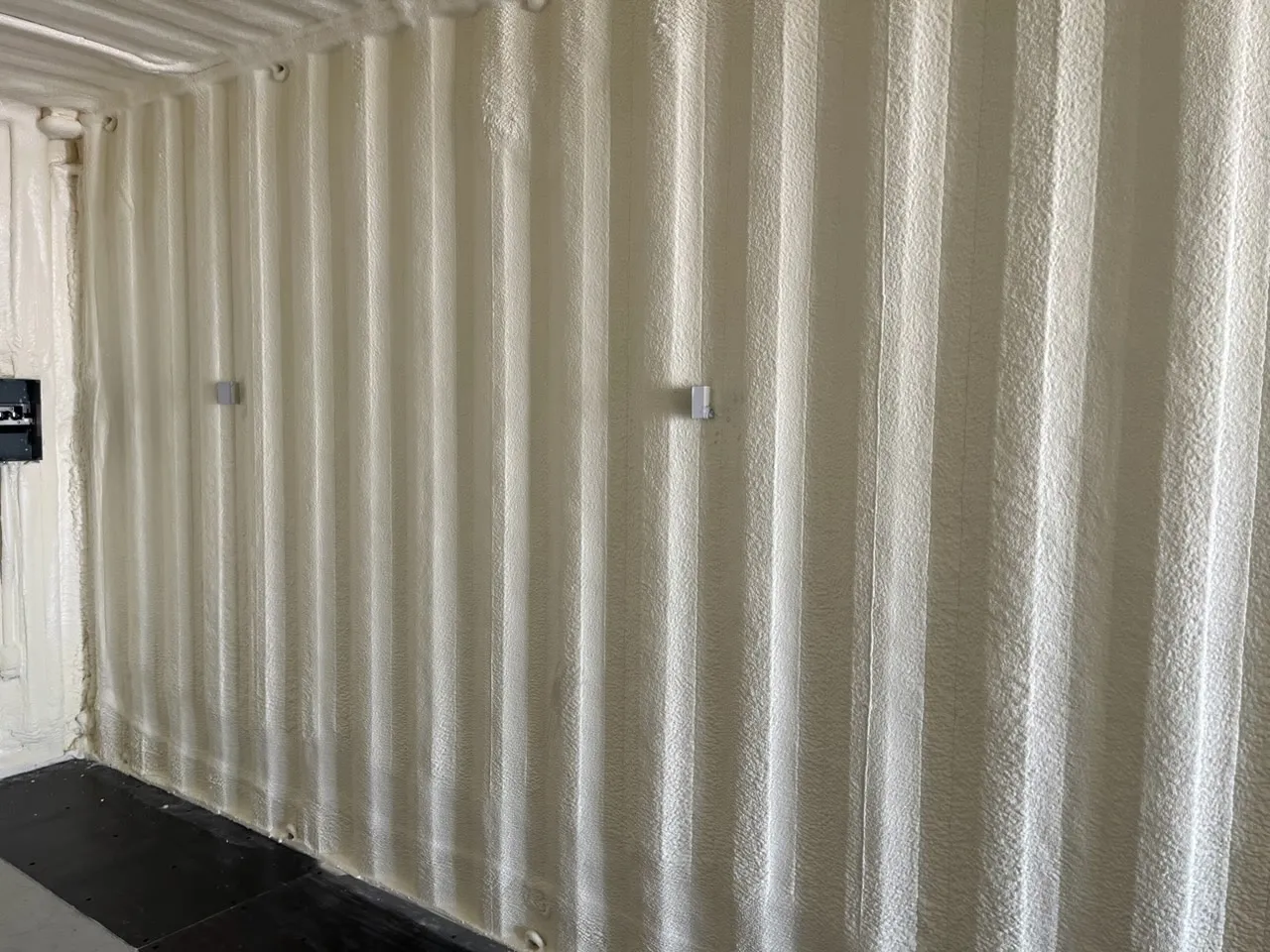
Closed cell at two inches on a container wall in northwest Houston. The ribs stay visible because the foam follows the steel instead of hiding it.
What closed cell foam actually is
Closed cell polyurethane foam is sprayed as two liquids that meet at the gun tip and cure in seconds. The cells that form are sealed off from each other and filled with a blowing agent instead of air. That is the whole reason it behaves the way it does. Sealed cells mean the foam is rigid, dense at roughly two pounds per cubic foot, and unwilling to let air or water vapor pass through.
In Houston that last part carries most of the weight. We do not have a heating problem, we have a moisture problem with a heat problem attached. Warm outdoor air holding a lot of water wants to move into cooler conditioned space. Fiberglass slows the heat but the air goes right through. Closed cell foam at two inches or more acts as a class II vapor retarder and an air barrier at the same time, so the drive stops at the foam.
The other thing you get is structure. Two inches of closed cell bonded to the inside of a 26 gauge steel panel makes a wall that no longer drums when the wind hits it. On older wood decks it glues the sheathing to the rafters. Testing on wind uplift has shown meaningful gains, which is one reason we get calls after a hurricane season.
Where we spray it
Metal buildings and shops
A metal building in Harris County is a solar oven with a slab in it. Steel conducts heat straight through and condenses water on the inside face every humid morning. Closed cell sprayed directly to the underside of the roof panels and the inside of the wall panels solves both problems in one pass. There is no vapor barrier to install, no batts sagging out of the purlins in year three, and no dripping over your tools.
Shipping containers and container offices
Containers are the clearest case for closed cell. There is no cavity, the wall is corrugated, and any air gap behind an insulation panel becomes a condensation trap. We mask the floor and the door seals, spray the walls and ceiling to the thickness you need, then trim around hardware and electrical boxes. Two inches is typical for storage. Three inches is what we recommend for anything with a person or a piece of climate sensitive equipment inside.
Crawl spaces, band joists and pier and beam
Older Houston houses on pier and beam lose a lot of comfort to the space under the floor. Closed cell on the subfloor and the band joist seals the perimeter, stops the humid air from wicking up into the floor system, and keeps the ducts down there out of trouble.
Walls that have flooded
After Harvey we sprayed a lot of rebuilt walls. If a wall has taken water once, it can take water again, and a material that does not absorb it is worth the extra cost. Closed cell does not hold water, does not feed mold, and does not slump.
Rule of thumb we use on estimates: two inches of closed cell for storage and shell buildings, three inches for occupied metal buildings, three to four inches for a roof deck you want to condition.
R value, thickness and code
Closed cell runs about R-6.5 per inch, sometimes R-7 depending on the product lot and the substrate temperature. Houston sits in climate zone 2A. For a roof deck brought inside the envelope, three to four inches gets you into the range inspectors expect on residential work, and it gets there in less depth than any other option. On a metal building the driver is usually condensation control rather than a code number, so we spec by dew point and by what the space is used for.
We spray in lifts, never one thick pass. A two inch job is two passes of about an inch each with time between them. That matters because thick single passes trap heat while the foam cures, which is how you get poor adhesion and a smell that lingers. Slower is better and it is the difference between foam that lasts thirty years and foam that comes off the wall.
What a closed cell job looks like on your calendar
You should stay out of the sprayed area during application and for a few hours after. We ventilate while we work and we will tell you plainly when the space is ready to use, which for most jobs is the same evening.
Honest tradeoffs
Closed cell costs more per square foot than open cell. On a big attic that difference is real money, and there are plenty of houses where open cell is the smarter buy. Closed cell is also rigid, so it will hide a small roof leak instead of showing you a stain. If your roof is near the end of its life, replace or repair it first and then call us.
And it is not a magic number generator. Foam works because it seals air. If the ductwork is disconnected in three places or the returns are undersized, foam will help but it will not fix the HVAC system. We will say so when we see it rather than sell you insulation that cannot deliver.
Why Houston owners call us for it
We are a Houston crew working out of 6522 Lozano St, and closed cell is the majority of what we spray. That means the rig is set up for it, the material is fresh, and the person quoting your job is the person who has sprayed a hundred buildings like it. We show up when we say we will, we quote in writing, and we clean up like the building belongs to us.
Call (713) 281-9585 or email tenergyfoam.av@gmail.com with the address, the square footage and a couple of photos. If closed cell is not the right answer for your building, we will tell you that too.