
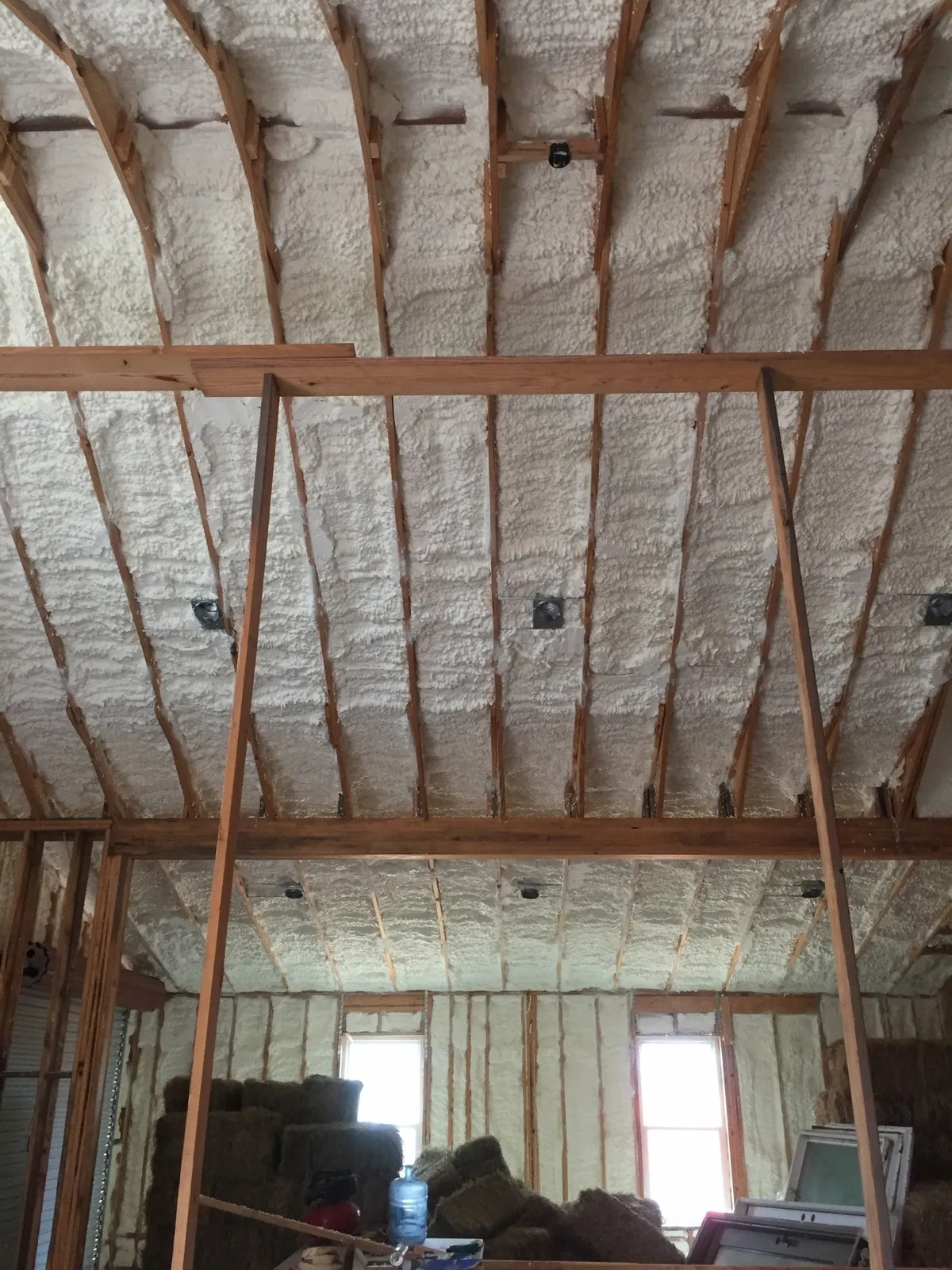
Open cell on the roof deck of a Spring Branch attic. The foam expands into every bay and around each rafter.
How open cell behaves
Open cell foam is the same chemistry family as closed cell with a different formulation. The cells break open as the foam rises, so the finished material is soft, light at about half a pound per cubic foot, and full of air. It expands to roughly a hundred times its liquid volume, which is the property that makes it so useful in framing. You cannot fit a batt into the gap behind a wire or around a truss gusset. Foam that expands that much fills it without being told.
Because the cells are open, water vapor can move through it. That sounds like a weakness and in a cold climate it can be. In Houston, on a roof deck that has been detailed correctly, it is often an advantage: if the roof starts leaking, the water finds its way to the ceiling and shows itself instead of sitting hidden against the sheathing. Plenty of Houston builders specify open cell on the deck for exactly that reason.
Open cell is also the better sound absorber. The open structure kills mid and high frequency noise, which is why we get asked for it in media rooms, in walls between bedrooms and offices, and in houses near a busy road or a flight path.
Where it makes the most sense
Unvented attics
The standard residential application. We spray the underside of the roof deck, seal the gable ends, and close the soffit vents in the process, which turns a vented attic into a semi conditioned space inside the thermal envelope. Six inches of open cell gets you around R-22, which is what most Houston inspectors are looking for on a deck. Your ductwork ends up in air that is close to room temperature.
Interior and exterior walls
In a 2x4 wall, three and a half inches of open cell fills the cavity, seals around the outlet boxes, and stops the draft you feel at the baseboard. In a 2x6 wall we go the full depth. Either way we shave the face flush so the drywall crew has a flat plane to work with.
Sound control
Bedroom and bathroom party walls, upstairs floor systems, laundry rooms, home offices. Open cell in an interior partition is a cheap upgrade at framing stage and one of the things homeowners notice most after move in.
Metal buildings that are already dried in
Sometimes a shop already has a vapor barrier or a lined panel system, and the owner just wants insulation value. Open cell can work there and it costs less. We will only recommend it if the assembly can handle vapor movement, otherwise it is closed cell.
Typical Houston attic spec: 5.5 to 6.5 inches of open cell on the roof deck, gable ends foamed, top plates and penetrations sealed, soffit vents closed.
Cost, coverage and what drives the number
Open cell is priced per board foot, meaning one square foot at one inch thick. Because you get more thickness for your money, a 1,800 square foot attic done in open cell usually comes in well under the same attic done in closed cell. What moves the price is access, pitch, obstructions and prep. A walkable attic with a wide hatch and no old insulation is the cheap version. A low slope attic full of packed cellulose that has to come out first is the expensive version, and the removal shows as its own line on the quote.
We do not spray over old insulation on a deck. It has to come out, both because foam needs a clean substrate to bond to and because you do not want to seal damp fiberglass under a new air barrier. If your attic needs that, see our insulation removal page for how we handle it.
The day of the job
Plan to be out of the house or at least off that floor while we spray, and expect a smell during application that clears with ventilation. By that evening most families are back to normal.
Where open cell is the wrong call
We will steer you to closed cell if the substrate is steel, if the space is a crawl space or a cooler, if you are insulating a container, or if the assembly needs a vapor retarder to work. We will also stop and talk if your roof is old. Open cell against a deck with a leaking roof will let the water through to your ceiling, which is better than hiding it, but it is still water in your house. Fix the roof first.
And if a contractor tells you open cell in Houston is always wrong, that is a sales line. Thousands of homes here run open cell on the deck and perform fine when the details are right. The right answer depends on the assembly, and looking at the assembly is what our estimator does.
Get a number for your attic
Tell us the square footage of the house, the age, whether there is insulation up there now, and whether the second floor is the room nobody wants to sleep in. That is usually enough for a ballpark on the phone, and a short site visit turns it into a written quote. Call (713) 281-9585 or email tenergyfoam.av@gmail.com.