
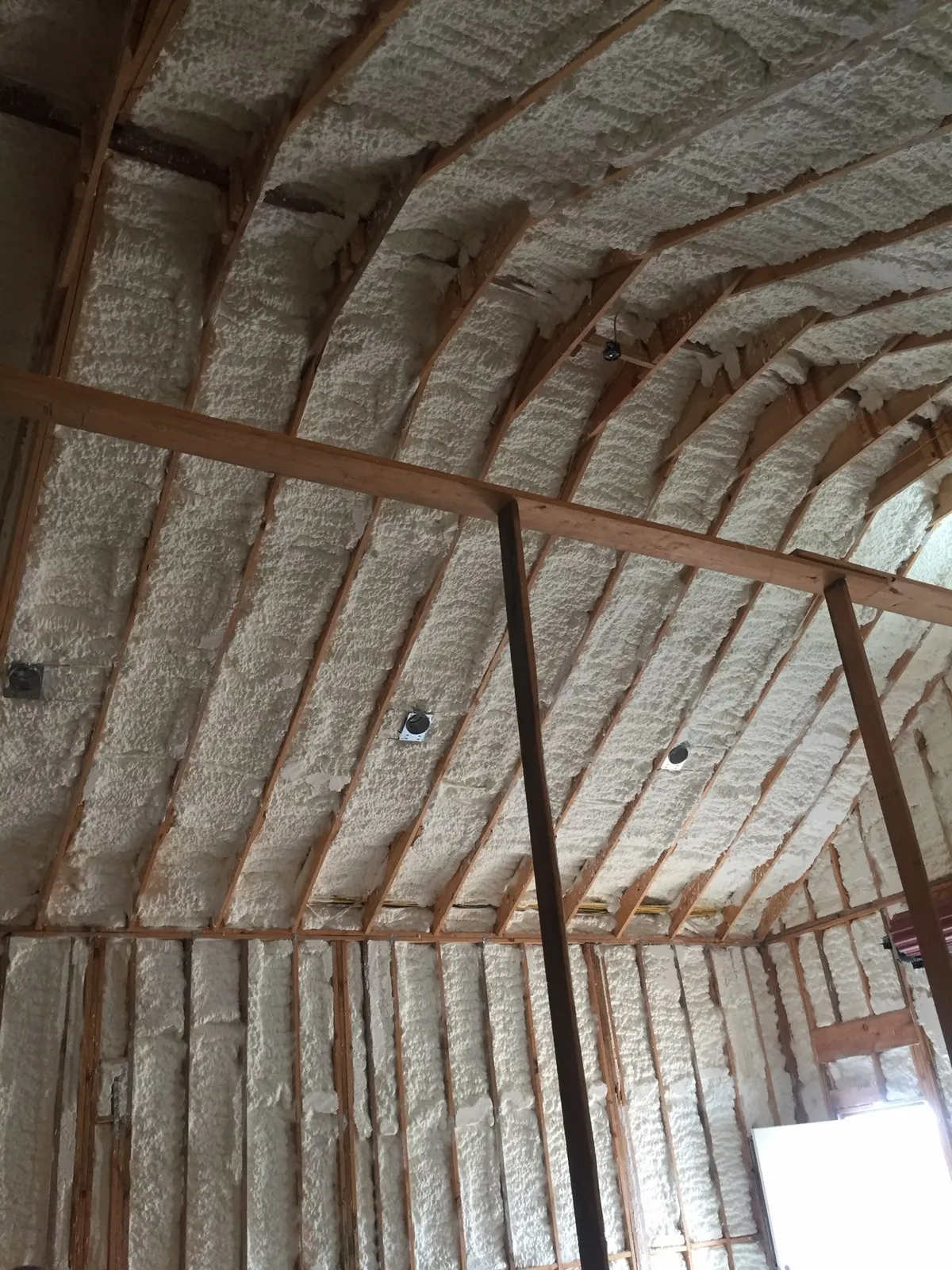
Roof deck foamed to the ridge. The attic below now sits within about fifteen degrees of the house.
Start with the roof surface
A dark composition shingle roof in Houston in July reaches 160 to 180 degrees on the surface. That heat conducts through the shingles and the decking and radiates off the underside of the plywood into the attic. Nothing about ridge and soffit vents stops radiation. Venting moves air, and moving 95 degree humid air through a space that is being radiated at from above does not bring the temperature anywhere near comfortable.
Put a thermometer in a typical vented Houston attic at 3:00 pm and you will read 130 to 145 degrees. The framing is hot. The decking is hot. Anything stored up there is hot. And critically, the air is hot and wet at the same time.
Then look at what lives up there
In most Houston houses built since the 1970s, the entire cooling system is in the attic: air handler, evaporator coil, supply plenum, and every branch duct running out to the rooms. So you have a machine whose whole job is to deliver 55 degree air, sitting in a 140 degree room, pushing that air through flex duct that also sits in the 140 degree room.
Duct leakage on an older system commonly runs 15 to 25 percent. Every cubic foot of that leaks into the attic, and every cubic foot has to be made up by pulling air in from somewhere, usually through leaks in the ceiling plane, which means pulling in 140 degree humid attic air. Then there is conduction: even with intact insulation on the duct, that temperature difference bleeds heat into the airstream the whole way to the register. The room farthest from the air handler gets the worst of it, which is why the back bedroom upstairs is always the problem.
A house can have a correctly sized, well maintained air conditioner and still fail to cool the second floor, simply because the delivery system is running through an oven.
The humidity part nobody mentions
Cooling is only half of what your system does here. The other half is dehumidification, and it happens when the system runs long enough for the coil to keep condensing water. A system fighting heavy attic driven load short cycles: it satisfies the thermostat, shuts off, the load comes right back. Short cycles remove less water. That is why a house can read 74 degrees on the thermostat and still feel clammy.
Reduce the attic driven load and cycles get longer and steadier. The coil stays wet, the house dries out, and 76 degrees starts to feel better than 74 did before.
What changes when you foam the deck
Spray foam goes on the underside of the roof deck instead of on the attic floor. The soffit vents get sealed, the gable ends get foamed, and the attic becomes an unvented, semi conditioned buffer space inside the thermal envelope.
What it is worth in dollars
We are careful with this claim because it varies. Owners who foam a previously vented attic in Houston commonly report summer cooling bills 20 to 35 percent lower. Houses with badly leaking ducts in the attic see more, because the losses were larger to begin with. Houses that were already tight with well sealed ducts see less.
The thing that does not show on the bill is the equipment. A system that runs 30 percent less through five Houston summers has meaningfully more life left in it. And a second floor that is finally usable in August is worth something that does not appear on any utility statement.
Before you call anyone
Two checks worth doing yourself. First, go up in the attic in the morning while it is still tolerable and look at the insulation depth. If you can see the tops of the joists, you have almost nothing. Second, look at the duct runs. If you see crushed flex, disconnected boots or tape hanging loose, that is a repair to make regardless of what you do about insulation.
If your roof is more than about eighteen years old, get a roofer's opinion before you foam. Foam on the deck is a long term assembly and you want a sound roof over it.
What we would do at your house
Remove whatever is on the attic floor, air seal the chases and top plates, then spray the deck and the gables. Open cell at five and a half to six and a half inches for most wood framed attics, closed cell at three to four inches where the assembly calls for it. One day for most homes.
Details are on our attic insulation page, and if you want to talk it through, call (713) 281-9585.