
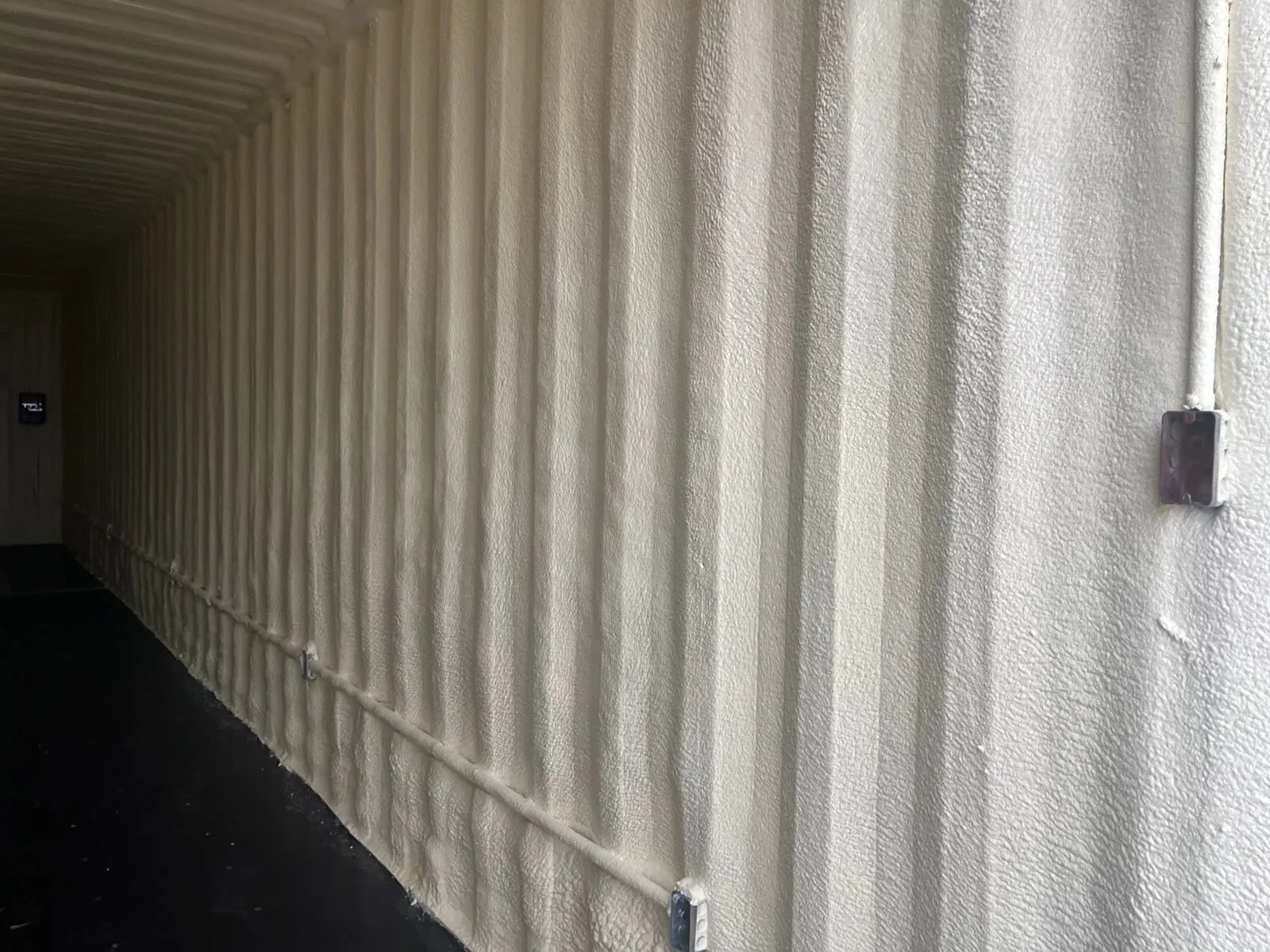
A 40 footer finished in one afternoon. Foam follows the corrugation, so nothing is left behind the insulation for air to move through.
Why the obvious methods fail
Rigid foam board
Board is flat, container walls are corrugated. Every ridge leaves an air channel behind the board, and every channel is a place where interior air reaches cold steel and condenses. You end up with water running down inside the wall you just built. Sealing every channel with tape and canned foam is possible in theory and does not survive contact with reality.
Fiberglass batts in a framed wall
Framing out the inside of a container and stuffing batts in costs you three to four inches of interior width on each side, and it puts a permeable material against unsealed steel. In Houston humidity, that assembly sweats and the batts get wet. It also eats floor space you paid for.
Reflective bubble wrap
Sold hard for containers. It gives you a fraction of the R value people expect and does nothing about air. It has a use as a radiant layer with a real air gap, but as the sole insulation on a container in a hot humid climate it does not work.
Every failure has the same cause: an air gap between the insulation and the steel. The steel stays cold, so the water goes there.
Why closed cell foam is the answer here
Sprayed closed cell bonds directly to the corrugated steel and follows every ridge and valley. There is no gap. The insulation and the vapor retarder and the air barrier are the same layer, applied at the same time, with no seams to detail.
Thickness by use
We spray walls and ceiling as standard. Floors are usually left alone in a storage container, since the marine plywood is already there and the ground under it is not the main heat path. For an occupied conversion, we talk about the floor separately.
How we do a container
Prep matters more than people expect, because everything in a container is close to everything else. We mask the door gaskets, the locking hardware, the vents and any electrical, and cover the floor completely. Then we spray the ceiling first and the walls after, in lifts, with a fan pulling air out of the far end. After cure we trim around hardware, cut back anything that would interfere with the door seal, and pull the masking.
A 20 foot container is a couple of hours. A 40 foot container is an afternoon. If you have a fleet, we set up in your yard and work down the line, which is cheaper per unit than one at a time.
What it costs
Container work is priced by interior surface area and thickness, plus mobilization. A single 40 footer at two inches is a small job with a fixed setup cost, so per square foot it looks expensive next to a warehouse. Fleets of four or more get a volume number because we only set up once. Send us the count, the sizes and the yard address and we will give you a per unit price.
Details that catch people out
Doors. A container's doors are the weak point and foam on the door leaf has to be trimmed carefully so the cam locks still work and the gaskets still seat. Ventilation: once you seal a container, whatever moisture gets in stays in, so an occupied box needs mechanical air. Ignition barrier: exposed foam in an occupied container generally needs a covering, which we can spray as an intumescent coating. And placement, because it is much easier for us to spray a container where a truck can park next to it.
We do a lot of these
Container work is one of our specialties, and northwest Houston has plenty of yards. If you are converting a box into an office, a shop or a gym, or you just want your storage to stop raining on your inventory, call (713) 281-9585 or email tenergyfoam.av@gmail.com. Photos of the container and its surroundings are all we need to start.