
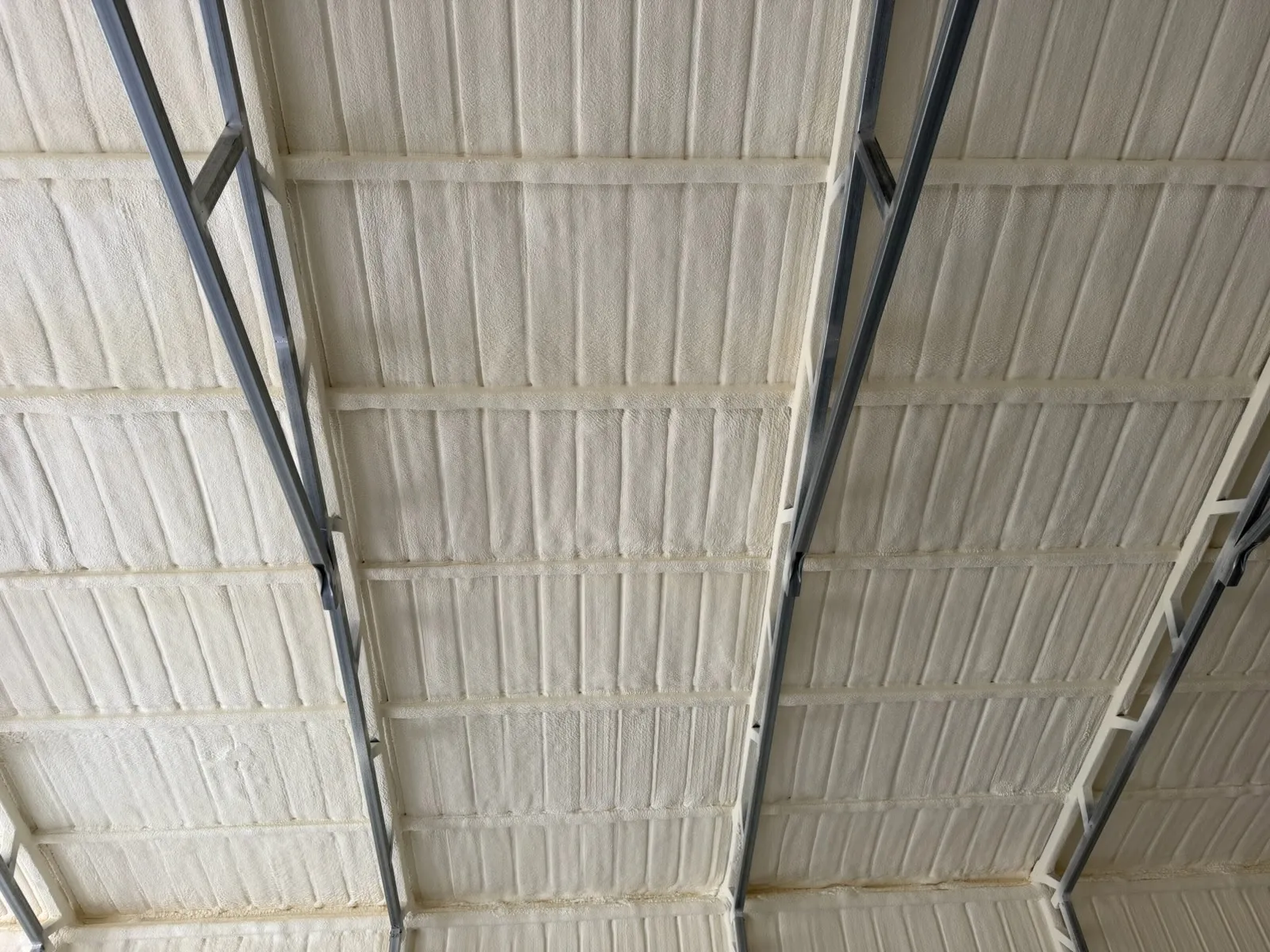
Foam applied directly to the underside of the roof panel and around the purlins. The steel is no longer the cold surface in the room.
How to tell condensation from a leak
Three tells. First, timing: a leak shows up during or right after rain, condensation shows up on clear nights and cool mornings, especially in spring and fall when a warm humid day is followed by a cold front. Second, pattern: a leak concentrates at a seam or a fastener and runs down in a line, condensation appears as sheeting or a fine mist of droplets across a whole panel. Third, location: condensation is worst on the north slope and on any panel with sky exposure and no insulation behind it.
If you have walked your roof twice and found nothing, and the water keeps coming back after dry weather, it is condensation.
Why it happens here more than almost anywhere
Air holds water in proportion to its temperature. Houston air is warm and it holds a lot. When that air touches a surface below its dew point, the water comes out of solution on that surface. Bare steel is a very good conductor with almost no thermal mass, so it tracks the outdoor temperature closely. On a clear night the roof panel radiates heat to the sky and drops below the outdoor air temperature. Inside the building the air is still warm and full of water from the day. The two meet at the panel and you get water.
Add sources: a wet slab, vehicles coming in from rain, welding, washdown, propane forklifts, plants, people. Every one of those puts water into the air inside your building.
Ventilating a metal building in Houston does not fix condensation. You are bringing in more humid air. Fans move the problem around.
Why fiberglass liner systems disappoint
The standard metal building answer has been a vinyl faced fiberglass blanket laid over the purlins before the panels go on. It works reasonably at first. Then time happens. Compression at every purlin thins the insulation to almost nothing at the fastener line. The facing punctures during installation. Birds and rodents open it up. Air moves behind it, reaches the panel, and condenses out of sight in the blanket instead of on your floor. Now you have wet fiberglass, rust starting at the fastener, and a stain nobody can trace.
The problem is not the fiberglass, it is the air gap. Any insulation with air moving behind it lets the panel stay the cold surface.
What closed cell foam does differently
Sprayed closed cell is applied directly to the underside of the panel. It bonds to the steel, so there is no gap, no air movement, and no condensing plane. The interior face of the foam is now the surface exposed to your building's air, and that surface sits close to interior temperature instead of outdoor temperature. Dew point is never reached, so nothing condenses.
Costs of leaving it alone
Rust on the fasteners and at the panel laps, which shortens the roof's life. Rust on tooling and inventory. Cardboard packaging that fails. Mold on anything organic sitting near the floor. Slick concrete, which is a real safety issue in a building with forklifts. And a working environment that peaks near 110 degrees inside during summer, which costs you productivity whether or not it shows up on an invoice.
What a job looks like
We walk the building, measure the roof and wall area, note the ceiling height and what has to be protected, then quote it. On the day, we cover racking and equipment, set up ventilation and access, and spray the deck first and the walls after. A 40 by 60 shop is typically one day. Larger buildings get phased so you keep operating, and we work nights and Saturdays when that is easier for you.
If your existing liner is sagging or torn, we strip it first. That is on our insulation removal page, and it is a bigger improvement than most owners expect.
Get it stopped before the next front
Spring and fall are when we get the most condensation calls, because that is when the temperature swings are sharpest. If your floor is wet this month, book a walkthrough now rather than waiting for it to happen again.
Call (713) 281-9585, email tenergyfoam.av@gmail.com, or read more on commercial and industrial foam.